
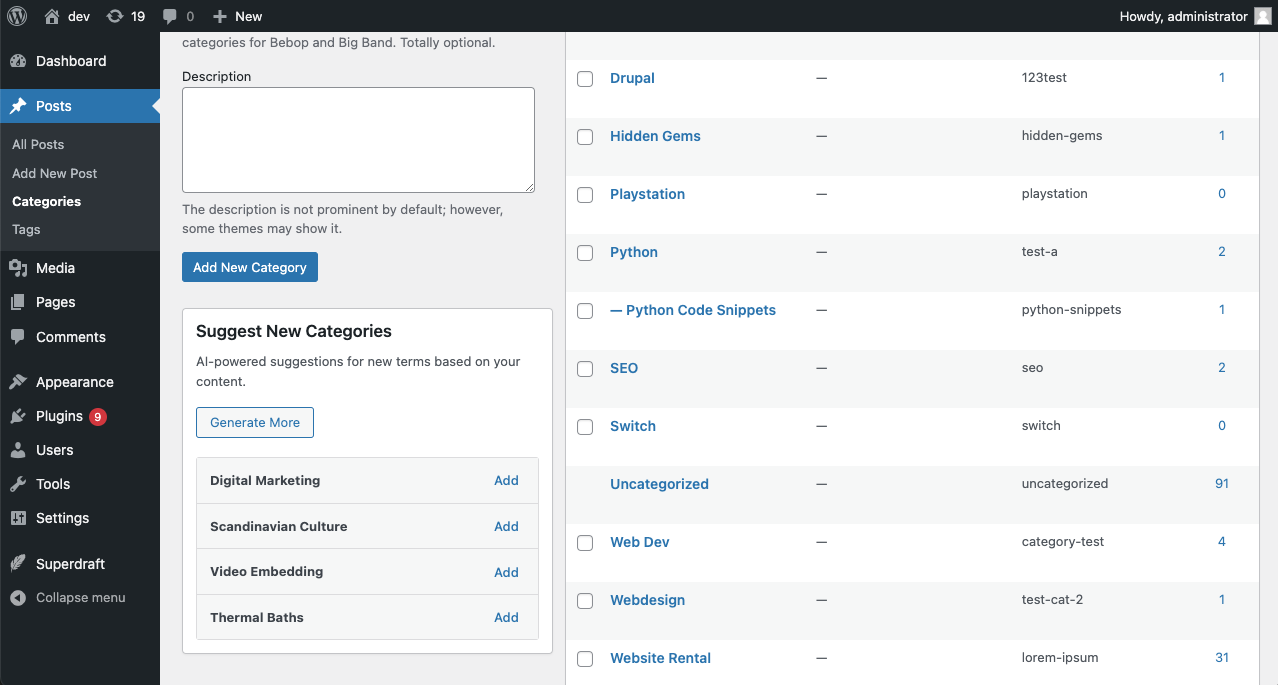
AI-generated tags and categories suggestions
Superdraft is a comprehensive, free WordPress plugin designed to enhance your content creation workflow by seamlessly integrating intelligent AI tools into your WordPress interface.
This plugin provides:
- AI-powered writing assistance and recommendations
- Intelligent tag and category management
- Smart autocomplete for faster content creation
- AI-powered image generation and editing (with Nano Banana Pro and other models)
- Support for numerous AI models (including free, locally hosted, and custom models)
- Detailed logging, customization, and multilingual support
Plugin Highlights:
- Free and Open Source – No ads, accounts, or limitations
- BYOK (Bring Your Own Key) – Use your own API key, do not pay a middleman
- Flexible AI Models – Supports 30+ AI models and can be extended with custom models
- Feature-Specific Models – Set distinct AI models for specific functions
- Multilingual – Plugin interface and AI prompts are fully translatable
AI-Generated Tags & Categories
Automatically suggests and assigns tags/categories based on your content, even in bulk edit mode. Features:
- Bulk tagging with adjustable API rate-limit intervals
- Customizable suggestion quantities and context lengths
AI Topic & Writing Recommendations
Real-time sidebar suggestions for writing tips, content improvements, and SEO advice. Features:
- Instant updates while writing
- Easy customization and editing directly from the block editor
AI Autocomplete
Intelligent, context-aware suggestions triggered by customizable prefixes. Features:
- Customizable prefix triggers
- Adjustable suggestion count and context lengths
Image Generation & Editing
Create and edit featured images directly in the post editor using AI technology, just like in ChatGPT or Gemini. Features:
- Text-to-image generation with custom prompts
- Smart prompt generation from post content
- Precise image editing with instructions-based modifications (through Google’s Gemini API, or OpenAI’s advanced GPT image generator)
- WordPress media library integration
- Support for various image generation and editing models including Nano Banana Pro, Imagen 4, Seedream 4.5, Ideogram, and more
Smart Compose
Inline, real-time sentence completions similar to Gmail’s Smart Compose. Features:
- Accept suggestions via keyboard or mouse
- Configurable delays and token limits
- Seamless integration with paragraph blocks
Advanced Logging and Configuration
Superdraft includes detailed logging to track usage, API requests, and responses.
Customizable Prompts
Easily customizable AI prompts stored as text files, allowing overrides via themes, child themes, or custom plugins. Ships with English and Hungarian templates by default.
Developer-Friendly
Extensive hooks (filters/actions) are provided for advanced customization:
- Adjust request headers/body
- Customize prompt templates and variables
- Change intervals for bulk processes and more
More information on these hooks can be found on the GitHub page.
External Services
The Superdraft plugin relies on third-party AI APIs for its AI-driven features. No data is transmitted until you configure your chosen API connections in the plugin settings.
Google Generative Language API
Used for generating AI-based content suggestions, tags, categories, autocomplete, and writing recommendations.
Sends post content, excerpts, titles, and context when AI-driven features are triggered by user actions.
– Terms of Service
– Generative AI Additional Terms
– Privacy Policy
OpenAI
Used for AI-driven features including autocomplete, content suggestions, tags, categories, and writing assistance.
Sends post content, excerpts, titles, and contextual information when users interact with AI features.
– Terms of Use
– Privacy Policy
xAI
Used for AI-based content enhancements, including autocomplete, tagging, categorization, and writing recommendations.
Sends relevant post content, excerpts, titles, and context based on user-triggered AI feature requests.
– Terms of Service
– Privacy Policy
Anthropic
Used to provide AI-driven content suggestions, smart compose, autocomplete, and content organization features.
Transmits post content, excerpts, titles, and surrounding context when the user activates related AI features.
– Terms of Service
– Privacy Policy
Custom API Connections
Superdraft offers the flexibility to set up custom API connections beyond the standard providers. You can configure connections to alternative OpenAI-compatible endpoints. This allows for complete independence from external services when required.
API Logging and Monitoring
All API interactions are logged and accessible directly from your WordPress dashboard. This transparent logging system allows you to monitor exactly what content is being sent, to which endpoints, and when these transmissions occur. These comprehensive logs provide peace of mind and help troubleshoot any issues that may arise during operation.
JS Build Process (Technical)
The plugin uses a custom Webpack configuration to bundle and minify JavaScript files. Please see the GitHub page for details on the JS build process, and the source files used to create the final build.
Advanced Customization
Superdraft provides extensive customization opportunities via prompt templates stored in the prompts directory:
add-terms.txt: New tags/categories suggestionsassign-terms.txt: Tag/category assignmentautocomplete.txt: Autocomplete suggestionssmartcompose.txt: Inline sentence completionswriting-tips.txt: Content improvement and writing adviceimage-prompt.txt: Generate image prompts based on the post title and content
Override these by copying templates into your theme’s superdraft directory, or via provided hooks.
Superdraft also comes with a number of filters and actions for advanced customization. For example, you can adjust request headers, customize prompt templates and variables, change intervals for bulk processes, and more.
Requirements
- WordPress 6.0 or higher
- PHP 7.4 or higher
- Compatible AI provider API key (OpenAI, Google AI, custom)
Contributing
Contributions are welcome via GitHub issues and pull requests.
License
GPL-3.0 or later – https://www.gnu.org/licenses/gpl-3.0.html